
Content.One
Content.One uses AI to help marketing teams manage, scale, and deliver content seamlessly across multiple websites and global markets.
Visit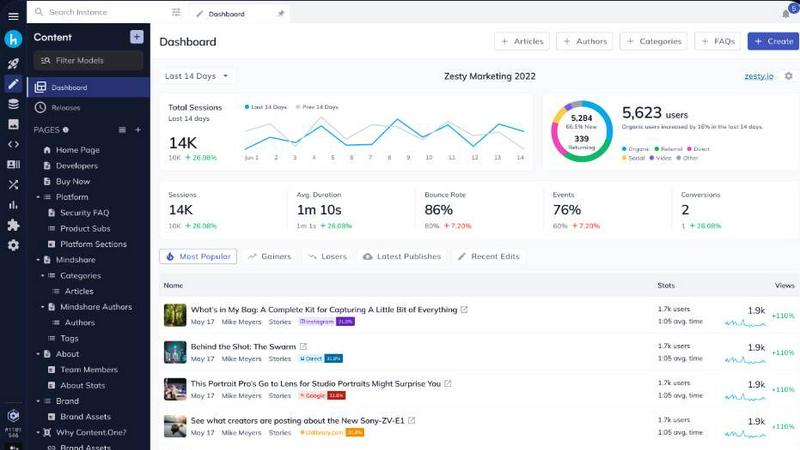
About Content.One
Content.One is a next-generation, AI-native content management system (CMS) purpose-built for modern marketing teams. After over two decades in the web content management industry, the platform was launched to fundamentally rethink how organizations create, manage, and scale digital content. At its core, Content.One leverages Model Context Protocol (MCP) to allow marketers to build entire websites, multi-site networks, workflows, schemas, and wikis directly from natural language prompts, eliminating the traditional need for developer intervention. The platform serves as a central control hub where teams can define reusable blocks, orchestrate agentic page building, and deliver seamless content experiences across websites, mobile apps, and headless channels. Content.One is designed for content teams, CMOs, CIOs, and IT leaders who need enterprise-grade security, governance, and scalability without sacrificing speed or creativity. Its main value proposition is the radical acceleration of content production: what historically required 40 hours of manual site building can now be accomplished in approximately 90 minutes using AI-powered workflows. The system also offers unique capabilities such as converting screenshots of any website or design into clean, manageable HTML, deeply integrated analytics from Google Analytics, and automated SEO monitoring. By empowering marketers to move from concept to live content in minutes rather than weeks, Content.One positions itself as an indispensable tool for organizations looking to operate with agility in a competitive digital landscape.
Features of Content.One
Agentic Page Building
Content.One introduces agentic page building, a transformative feature that allows users to generate entire website pages simply by writing a prompt. The AI interprets the request, builds the page structure, and populates it with relevant content and design elements. This eliminates the need for manual coding or dragging and dropping components. Users can iteratively refine the output with additional prompts, making the process highly interactive and responsive to creative direction. The feature is designed to handle everything from simple landing pages to complex, multi-section layouts, drastically reducing the time from concept to publication.
Central Control Hub and Reusable Blocks
The platform functions as a central control hub where organizations can define and manage reusable content blocks. These blocks are standardized components that marketers and developers can use across the entire organization, ensuring brand consistency and operational efficiency. Instead of recreating common elements like headers, footers, call-to-action sections, or product cards for each new page, teams can pull from a shared library. This governance feature allows for global updates: changing a single block automatically updates every instance across all sites, which is critical for large organizations managing multiple brands or regional websites.
Headless APIs and Real-time Webhooks
Content.One is built with a headless architecture, providing robust APIs that enable content to be published anywhere, including websites, mobile apps, digital kiosks, and IoT devices. The platform supports real-time webhooks, which trigger custom workflows and integrations whenever content is created, updated, or deleted. This allows marketing teams to connect Content.One seamlessly with their existing marketing technology stack, including CRM systems, email marketing platforms, and analytics tools. The flexibility of headless delivery ensures that content is not confined to a single output channel, giving organizations complete freedom in how they reach their audiences.
Inline Analytics and Automated SEO
Intelligence is built directly into the content creation environment with Content.One. The platform integrates deeply with Google Analytics to display per-page metrics like page views, bounce rates, and conversion rates right inside the editor. This contextual data empowers content creators to make informed decisions without switching between tools. Additionally, the system includes automated SEO monitoring that actively analyzes content and suggests improvements for search visibility. This dual approach of inline analytics and proactive SEO guidance ensures that every piece of content is not only well-crafted but also optimized for performance from the moment it is published.
Use Cases of Content.One
Rapid Multi-Site Network Deployment
Organizations that need to launch and manage multiple websites across different regions, brands, or departments can leverage Content.One to deploy entire multi-site networks from a single prompt. Instead of building each site from scratch, marketing teams define the global structure, branding, and content rules, and the AI generates individual sites that adhere to those parameters. This use case is particularly valuable for franchise chains, global enterprises, and government agencies that require consistent branding and governance across dozens or hundreds of localized sites, all managed from one central platform.
Converting Designs into Functional HTML
A standout use case for Content.One is its ability to convert screenshots of any website or design into clean, manageable HTML. Designers and marketers can capture a visual concept from a competitor site, a mockup, or even a hand-drawn sketch, and the AI will reconstruct it as a fully functional, editable web page. This dramatically accelerates the prototyping and iteration process, allowing teams to move from inspiration to implementation in minutes. It also bridges the gap between design and development, reducing the friction that often slows down content production.
AI-Powered Content Workflow Automation
Marketing teams can use Content.One to create sophisticated content workflows entirely through natural language prompts. For example, a user can describe a workflow that includes content ideation, drafting, approval by a legal team, translation for three languages, and scheduled publication. The AI interprets the request and builds the entire workflow, including triggers, notifications, and handoffs. This use case is ideal for content teams that need to manage high volumes of content with complex approval chains, ensuring that nothing falls through the cracks while maintaining speed and accountability.
Enterprise-Grade Content Governance and Security
Large organizations with strict compliance and security requirements can use Content.One to enforce content governance across all departments. CIOs and IT teams can define user roles, permissions, and content validation rules that apply globally or to specific groups. The platform ensures that only authorized personnel can publish or modify content, and it maintains a full audit trail of all changes. This use case is critical for regulated industries such as finance, insurance, and government, where content accuracy and security are non-negotiable. Content.One scales securely across departments, providing enterprise controls without sacrificing the agility that marketing teams need.
Frequently Asked Questions
How does Content.One differ from traditional CMS platforms?
Content.One is fundamentally different from traditional CMS platforms because it is built on an MCP-native AI architecture. Traditional systems require developers to manually set up templates, configure workflows, and code integrations. Content.One allows marketers to accomplish all of these tasks through natural language prompts. The AI can generate entire websites from a single description, convert design screenshots into HTML, and automate complex workflows without any coding. This shifts the power from developers to content creators, dramatically reducing production time and enabling faster iteration.
Can Content.One integrate with my existing marketing tools?
Yes, Content.One is designed with headless APIs and real-time webhooks that facilitate seamless integration with existing marketing technology stacks. It can connect with CRM systems, email marketing platforms, analytics tools like Google Analytics, and other third-party applications. The platform provides the flexibility to publish content to any channel, including websites, mobile apps, and headless systems. This ensures that organizations can adopt Content.One without disrupting their current workflows or requiring a complete overhaul of their technology infrastructure.
Is Content.One suitable for non-technical marketing teams?
Absolutely. Content.One is specifically designed to empower non-technical marketing teams to build and manage complex digital experiences without developer assistance. The agentic page building feature allows users to create entire pages by writing prompts, and the visual editing interface provides an intuitive way to refine content. The platform also includes inline analytics and automated SEO suggestions that guide users toward better performance. Content.One removes the technical barriers that traditionally separate marketing ideas from their digital execution, making it an ideal tool for content creators, marketers, and CMOs.
What level of security and governance does Content.One offer?
Content.One provides enterprise-grade security and governance features suitable for large organizations and regulated industries. It includes role-based access controls that allow administrators to define exactly who can create, edit, approve, and publish content. The platform supports content validation rules to ensure compliance with brand guidelines and regulatory requirements. It also maintains a comprehensive audit trail of all content changes. Content.One scales securely across departments, enabling organizations to manage content governance centrally while allowing individual teams the flexibility they need to operate efficiently.
Explore more in this category:
Similar to Content.One

Get Your Brand Into the Answers Your Potential Customers Are Looking For.

Independent, source-checked guide to the Dear Passengers game.

401k Calculator.info is a free online tool to estimate retirement savings, employer match, and future 401(k) growth for smarter financial planning.

Ton To KG Calculator is a free online weight conversion tool that helps users instantly convert tons to kilograms with precision.

Sinneroggi delivers daily articles on Jannik Sinner's sport, life, and views, offering expert insights into his tennis career, personal moments, and.

LazySEO automates SEO article creation and publishing, driving traffic and saving time for founders with 30 posts a month.