
Serro AI
Serro AI ingests your tools to create live program memory, keeping human-agent teams aligned and coordinated at scale.
Visit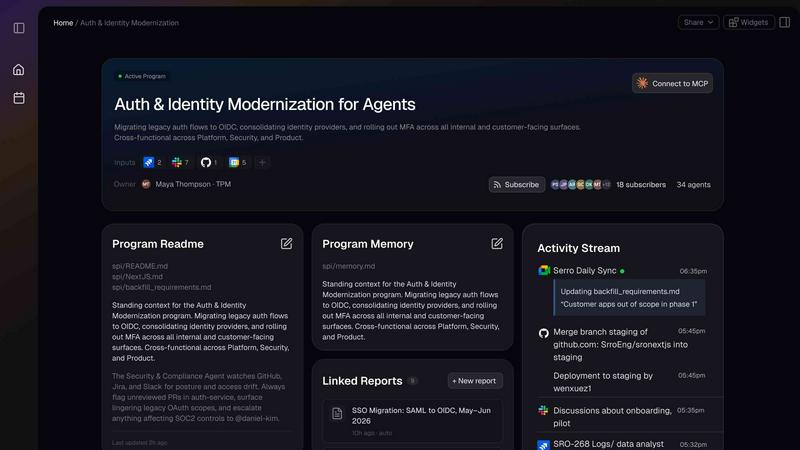
About Serro AI
Serro AI is an Agentic Technical Program Management (TPM) platform, purpose-built as the infrastructure for Program Engineering. It directly addresses the modern engineering bottleneck: while AI has dramatically increased code output and decision velocity, the coordination required to manage that output has not scaled. Serro is not a task tracker, roadmap tool, documentation wiki, dashboard, or generic project management platform. Instead, it treats programs as first-class units of work, transforming scattered execution signals from tools like Jira, GitHub, Linear, Slack, meetings, and roadmaps into two core outputs: trusted temporal program memory and real-time status coordination. The program memory is a living record of shared goals, decisions, risks, dependencies, and history that stays current automatically. The coordination layer allows both humans and AI agents to act on this live picture of organizational reality. Serro is designed for human-agent teams, acting as a shared control plane that keeps both aligned. It offers two tiers: Serro Pro, which helps enterprises scale existing TPM capacity so that TPMs, Engineering Managers, Product Managers, and engineering leaders can collaboratively manage downstream execution and agent loops; and Serro Lite, which gives earlier-stage companies AI-powered TPM capacity much earlier, allowing smaller teams to scale their live coordination without dedicated TPM hires. The product integrates where teams already work, allowing users to speak to it in meetings, message it in chat, and command it from existing tools. Built by operators in the USA, Serro is designed to pay for itself on day one by reducing coordination overhead and providing immediate ROI through increased program throughput and reduced context-switching.
Features of Serro AI
Program Memory
Serro maintains a live, automatically-updating memory for every active program. This memory stores the complete state of a program, including decisions made, risks identified, owners assigned, historical activity, and current status. Unlike static documents or wikis that require manual updates, Serro ingests signals from connected tools like Slack, Linear, GitHub, Jira, Zoom, and email to keep the memory current without any manual effort. This creates a trusted, temporal record that teams can query at any time to understand what happened, why decisions were made, and what is happening now. It eliminates the need to reconstruct context after meetings or search through disparate tools for the latest status.
Loops on Programs
Serro uses automated loops to keep complex work moving across teams and tools. These loops are designed to drive execution by continuously checking for updates, identifying blockers, and ensuring that dependencies are resolved. For example, when a meeting ends, Serro can automatically extract action items, assign owners, and add them to the program memory. When a code review is completed or a Jira ticket transitions, Serro updates the relevant program status and notifies stakeholders. These loops reduce the manual overhead of status chasing and follow-ups, allowing TPMs and engineering leaders to focus on strategic decisions rather than operational tracking.
Agent Governance
Serro provides a control layer for managing both programs and the AI agents that operate within them. As teams increasingly incorporate AI agents into their workflows, Serro ensures that these agents operate within defined boundaries and follow program policies. The governance layer includes controls for agent permissions, action approval workflows, and audit trails of agent activity. This allows organizations to safely deploy AI agents for tasks like status updates, risk detection, and dependency tracking, while maintaining human oversight and accountability. It ensures that agent-driven execution remains aligned with program goals and organizational policies.
Program Analytics
Serro offers a system-level view across the entire organization, providing analytics that show program health, coordination gaps, and operational risk in real time. Leaders can see which programs are on track, which are stalled, and where resources are needed. The analytics surface patterns across programs, such as recurring blockers, bottleneck teams, or coordination breakdowns. This data-driven view enables faster, more informed decisions at the leadership level, turning fragmented updates from multiple tools into a coherent, live picture of organizational health. It also provides ROI metrics, demonstrating the value of the platform from day one.
Use Cases of Serro AI
Technical Program Manager (TPM) Scaling
For TPMs managing multiple cross-functional programs, Serro acts as a force multiplier. It automates the overhead of status gathering, meeting follow-ups, and dependency tracking. The TPM can delegate these operational tasks to Serro's loops and agents, freeing themselves to focus on strategic alignment, risk mitigation, and stakeholder communication. Serro provides a single live view of all programs, showing timelines, blockers, ownership, and reporting in one place. This allows a single TPM to manage significantly more programs with less manual coordination, scaling their impact across the organization.
Engineering Manager (EM) Visibility
Engineering Managers use Serro to understand the reality of their teams' execution without chasing updates. By connecting their tools, EMs get a shared view of what is moving across teams, where execution is slipping, and what needs attention next. Serro surfaces risks and blockers automatically, allowing the EM to intervene early rather than discovering issues during status meetings. This keeps the EM close to delivery, risk, and team health, enabling them to make data-driven decisions about resource allocation and prioritization.
Product Manager (PM) Alignment
Product Managers use Serro to keep decisions, timelines, and execution aligned with product strategy. When roadmap shifts occur, Serro captures the decision, updates the relevant program memory, and notifies all affected teams. This ensures that product direction is tied to delivery progress and that teams are aware of changing priorities. PMs can query any program to get a status update, generate reports on cadence, and turn meeting outcomes into actionable tasks, all within the same system that tracks execution.
Engineering and Executive Leadership Visibility
Engineering leaders and executives use Serro to get a clear picture of organizational health in real time. Instead of relying on fragmented updates from multiple teams, they can view a system-level dashboard that shows momentum, blockers, coordination gaps, and operational risk across all programs. This enables faster, more informed decisions about strategic initiatives, resource investments, and risk mitigation. Serro transforms the leadership review process from a manual, backward-looking exercise into a live, forward-looking coordination activity.
Frequently Asked Questions
How does Serro integrate with existing tools like Jira, GitHub, and Slack?
Serro connects directly to your existing stack, including Slack, Linear, GitHub, Jira, Zoom, Notion, email, and your codebase. Once connected, it begins ingesting signals from these tools automatically. It does not replace these tools but instead acts as a coordination layer that reads and synthesizes data from them. Users can continue working in their preferred tools while Serro surfaces the relevant program context and status in a unified view. Commands can be issued directly from chat or meetings, and updates from connected tools automatically refresh the program memory.
What is the difference between Serro Pro and Serro Lite?
Serro Pro is designed for enterprises that already have dedicated TPM capacity. It helps scale that capacity by automating coordination overhead, allowing TPMs, EMs, PMs, and engineering leaders to collaboratively manage downstream program execution and agent loops. Serro Lite is built for earlier-stage companies that do not yet have dedicated TPMs. It provides AI-powered TPM capacity much earlier, allowing smaller teams to scale their live coordination without hiring specialized roles. Both tiers provide the same core program memory and coordination capabilities, but Pro includes additional features for enterprise-scale governance and analytics.
How does Serro ensure data security and privacy?
Serro is built with enterprise-grade security in mind. It is proudly built by operators in the USA and follows strict security protocols. The platform provides role-based access controls, audit trails, and data encryption both in transit and at rest. For agent governance, Serro includes a control layer that ensures AI agents operate within defined permissions and that all agent actions are logged and auditable. Organizations can configure policies to align with their internal compliance requirements. For specific security details, users can refer to the Security page on the Serro website or contact the partnership team.
Can Serro be used by teams that are not fully remote or distributed?
Yes, Serro is designed for any engineering organization, whether co-located, remote, or hybrid. Its value proposition of reducing coordination overhead and providing live program memory is relevant regardless of physical location. The platform integrates with meeting tools like Zoom and Slack, allowing it to capture decisions and action items from in-person or virtual meetings. For teams that are co-located, Serro still provides significant value by eliminating the need for manual status updates, reducing meeting overhead, and providing a single source of truth for program information that everyone can access.
Similar to Serro AI


privacy-first, AI-powered contact management platform

Custom PHP websites, AI Indexing Pack ($599 one‑time), and WebAgentScan SaaS ($9/mo). MCP, A2A, llms.txt, full ownership.