
Ember
Ember delivers daily AI market calls with public, uneditable scores and high conviction signals when three AI models disagree with real money markets.
Visit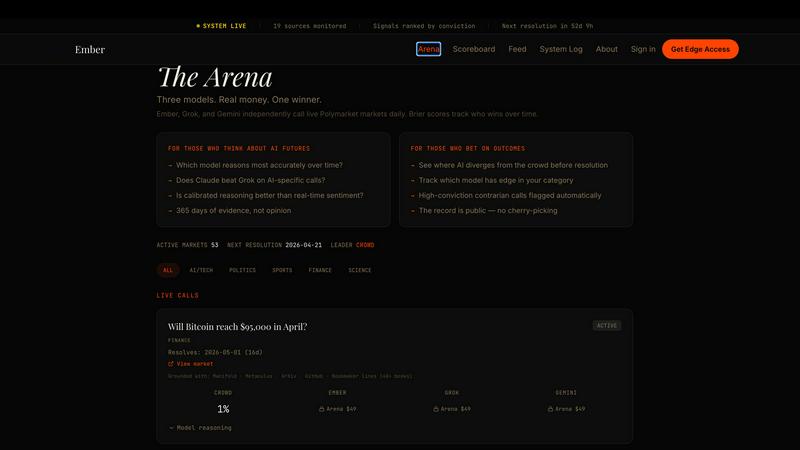
About Ember
Ember is a public AI prediction engine built on a premise of radical transparency: an AI that will not show its work is not worth trusting. Every morning at 7:00 AM EST, three genuinely independent AI models Claude by Anthropic, Grok by xAI, and Gemini by Google independently call live Polymarket markets before they resolve. They do not consult each other. When any model disagrees with the real-money crowd by 10 or more percentage points, that divergence is flagged as a high-conviction signal. Every call is timestamped before the outcome is known. Accuracy is tracked using Brier scores, a calibration metric that rewards both precision and confidence. The model that beats the crowd most consistently across a full 365-day period wins. Nothing is edited after the fact. Every wrong call receives a public post-mortem. The complete record builds in public view. Ember is designed for serious bettors, quantitative traders, AI researchers, and anyone who wants to see whether AI can reliably outperform collective human market intelligence. By forcing three different AI architectures to disagree and logging every result, Ember creates an auditable, transparent proof layer for prediction markets. Subscribers gain early access to signals at 7:00 AM EST, with public release following later. The edge is timing, and every call is locked forever before the outcome resolves.
Features of Ember
Three Independent AI Models Calling Daily
Ember runs three genuinely different AI models Claude by Anthropic, Grok by xAI, and Gemini by Google every morning at 7:00 AM EST. Each model independently assigns probabilities to live Polymarket markets without consulting the others. Claude reasons carefully from first principles using prediction markets, bookmaker lines, and AI research feeds. Grok reads real-time X sentiment for cultural and recency awareness. Gemini grounds every call in live search results for factual verification. When they disagree, that disagreement is logged as a signal. Consensus is not the goal.
Divergence Flagging with High Conviction Threshold
When any Ember model probability diverges from the Polymarket real-money crowd by 10 or more percentage points, that divergence is automatically flagged as a high-conviction signal. This threshold indicates meaningful disagreement between AI reasoning and collective human betting behavior. Either the crowd is wrong or the AI is wrong, and the public record shows which. Subscribers see these flagged signals first at 7:00 AM EST, before public release. The divergence system helps users identify where the most significant potential edges exist.
Immutable Public Record with Brier Score Tracking
Every call Ember makes is timestamped before the market resolves and locked forever. Nothing is edited, nothing is deleted, and nothing is retroactively changed. Accuracy is tracked using Brier scores, a calibration metric that rewards both accuracy and confidence in probability estimates. The model that beats the crowd most consistently across 365 days wins. Every wrong call gets a public post-mortem explaining what went wrong. The complete record builds transparently for anyone to audit.
Multi-Source Intelligence Synthesis Engine
Before making any call, Ember synthesizes data from over 20 sources across six feed categories. This includes real-money markets like Polymarket, Manifold, and Metaculus with volume filtering at 10k dollars. Sports odds come from The Odds API covering 40 plus bookmakers worldwide. AI research feeds include arXiv cs.AI, arXiv cs.LG, Hugging Face Papers, OpenAI Blog, DeepMind Blog, and Astral Codex Ten. Tools and emerging products are tracked via Product Hunt, Hacker News Show HN, BetaList, GitHub Trending, and Y Combinator launches. Three models reason over all this data independently.
Use Cases of Ember
Identifying Mispriced Prediction Markets
Serious bettors and quantitative traders use Ember to identify prediction markets where AI models diverge significantly from the crowd. When an Ember model shows a 10 plus point delta from Polymarket prices, it signals a potential mispricing. Users can investigate these divergences before placing their own bets. The public record of past calls helps users evaluate which AI model has the best track record for specific market categories like science, AI/tech, or politics.
Benchmarking AI Reasoning Against Collective Intelligence
AI researchers and developers use Ember as a live benchmarking platform to compare three different AI architectures against real-money market crowds. Claude, Grok, and Gemini each represent fundamentally different approaches to reasoning. By tracking Brier scores over 365 days, researchers gain empirical data on which reasoning styles outperform human collective intelligence in which domains. The public post-mortems on wrong calls provide valuable training data for improving AI calibration.
Gaining Early Signal Access for Trading Edge
Subscribers use Ember to gain early access to AI predictions before they become public. The signal drops at 7:00 AM EST for subscribers, with public release following later. This timing advantage allows subscribers to act on divergences before the broader market adjusts. For active prediction market traders, even a few minutes of early signal access can translate into meaningful edge, especially on rapidly resolving markets.
Auditing AI Transparency and Accountability
Regulators, journalists, and transparency advocates use Ember as a case study in accountable AI deployment. Every call is timestamped before outcome, locked forever, and accompanied by post-mortems on failures. The 365-day public record allows independent verification of AI performance claims. This sets a standard for how AI systems should operate when their outputs have real financial consequences. Users can audit any past call and verify it was made before the market resolved.
Frequently Asked Questions
What makes Ember different from other prediction market tools?
Ember is fundamentally different because it uses three genuinely independent AI models that are forced to disagree. Most tools aggregate opinions or use a single model. Ember logs every divergence and tracks accuracy using Brier scores over a full 365-day period. Nothing is edited or deleted after the fact. Every wrong call gets a public post-mortem. The entire record is auditable. This creates a transparent proof layer that shows exactly where AI outperforms or underperforms the crowd.
How does the divergence flagging system work?
When any of the three models assigns a probability that differs from the Polymarket real-money crowd by 10 or more percentage points, that divergence is automatically flagged as a high-conviction signal. The system does not require all three models to agree. In fact, disagreement between models is valuable data. Subscribers see these flagged signals at 7:00 AM EST before public release. The delta between the model probability and the crowd probability is clearly displayed, allowing users to evaluate the potential edge.
What is a Brier score and why does Ember use it?
A Brier score is a calibration metric that measures the accuracy of probabilistic predictions. It rewards both getting the outcome right and being appropriately confident. For example, predicting a 90 percent chance of an event that happens yields a better score than predicting 60 percent. Ember uses Brier scores because they provide a more nuanced view of performance than simple win-loss records. The model with the best Brier score over 365 days is the one that best calibrates its confidence with actual outcomes.
Can I see past calls and verify they were made before the outcome?
Yes. Every call Ember makes is timestamped before the market resolves and locked forever. The public record includes the exact time each call was made, the probability assigned, and the eventual outcome. Nothing is edited or deleted after the fact. Users can independently verify that calls were made before resolution by checking the timestamps. This immutability is a core design principle. Wrong calls also receive public post-mortems explaining what the model missed.
Pricing of Ember
Ember offers a subscription plan at 29 dollars per month. This subscription provides subscribers with early access to signals at 7:00 AM EST before public release. Subscribers can see the full divergence data including the Ember probability and delta from the crowd for all flagged markets. The subscription also unlocks the ability to view all live calls across multiple categories including science, AI/tech, and other markets. Public users can see limited information such as the crowd probability and market resolution dates, but the detailed AI model predictions and divergence signals require the subscription.
Similar to Ember


All-in-one POS, inventory, accounting and HR software for Bangladeshi SMEs — real-time sales, stock and finance in one place.


Free online PDF tools to merge, compress, convert, edit, sign, and manage documents—no signup, watermarks, or daily limits.