
StockFit API
StockFit API delivers clean, standardized financial data from SEC filings, ready for valuation, modeling, and backtesting.
Visit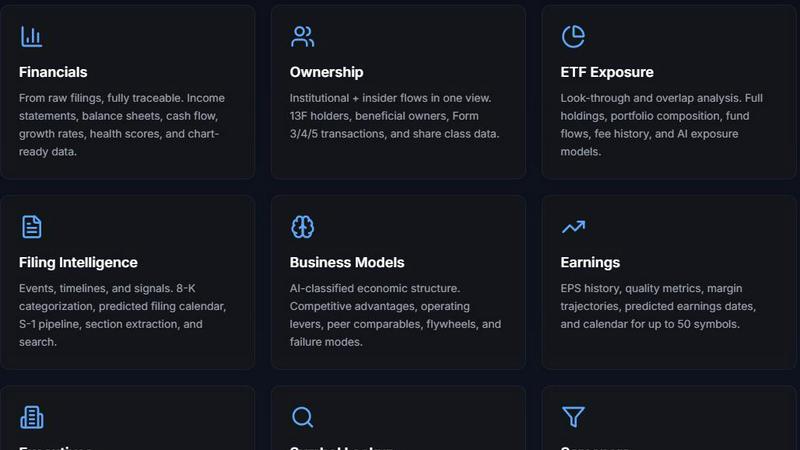
About StockFit API
StockFit API is a financial data platform built specifically for developers, quants, and research platforms who need direct, reliable access to SEC filing data without the usual compromises. If you have ever tried to build a financial model, run a backtest, or analyze company fundamentals using existing APIs, you have likely run into a frustrating choice: pay for cheap tiers that deliver inaccurate or incomplete data, or sign expensive enterprise contracts that drain your startup budget. StockFit fills that gap completely. The platform pulls financial data directly from SEC XBRL filings, meaning there is no derived middle layer and every single number is traceable back to its original filing. This gives you confidence that what you are modeling is accurate and auditable. StockFit covers fundamentals, ownership data, ETF and mutual fund exposure, insider transactions, and all types of filings. It handles complexities that other APIs ignore, such as amended filings, non-December fiscal years, and Q4 reconstructions from 10-K and 10-Q data. Beyond raw numbers, StockFit provides rich economic models per company including offerings, peers, operating levers, competitive advantages, flywheels, strategic initiatives, and failure modes. For ETF and mutual fund exposure, the platform models mandate, portfolio construction, costs, sensitivities, and use cases in an AI-friendly format perfect for LLM workflows. With over 250 million facts, 5 million filings, and daily updates, StockFit is built for serious financial analysis. The platform delivers standardized financials, sector-aware metrics, and source-cited economic models that are structured and ready for valuation and backtesting work. Users can access a playground for testing queries, comprehensive documentation, and insights to accelerate their research. StockFit is designed for those who demand accuracy, auditability, and depth in their financial data, eliminating the trade-off between cost and quality.
Features of StockFit API
Direct SEC XBRL Data with Full Audit Trail
StockFit pulls financial data directly from SEC XBRL filings, bypassing any derived or interpolated middle layers. Every single number returned by the API is traceable back to its original filing source document. This feature provides complete transparency and auditability, allowing users to verify any data point independently. For financial modeling, backtesting, or regulatory compliance, this direct lineage ensures that the data you are using is not a guess or an estimate but a verified figure from the company's own official filings. The API handles complex scenarios like amended filings and non-standard fiscal years, which other providers often mishandle or ignore.
Standardized and Model-Ready Financials
The API delivers financial statements that are standardized across companies and reporting periods, eliminating the problem of taxonomy drift that plagues raw SEC data. Income statements, balance sheets, and cash flow statements are presented in a consistent, model-ready format with common line items like revenue, cost of revenue, gross profit, operating income, net income, EPS, EBITDA, and more. This standardization saves developers and quants countless hours of data cleaning and normalization. The output is structured as clean JSON arrays with period dates, fiscal year designations, and comprehensive fact dictionaries, making it immediately usable in Python, R, or any other analytical environment for valuation models and backtesting engines.
Rich Economic Models for Companies
Beyond raw financial facts, StockFit provides deep economic models for each covered company. These models include detailed analysis of company offerings, peer comparisons, operating levers, competitive advantages, business flywheels, strategic initiatives, and potential failure modes. This feature transforms the API from a simple data provider into a comprehensive research platform. For ETF and mutual fund exposure, the platform models mandate, portfolio construction, costs, sensitivities, and use cases. All economic models are presented in an AI-friendly format, making them ideal for powering large language model (LLM) workflows and advanced analytical applications that require contextual understanding of a business.
Comprehensive Data Coverage and Daily Updates
StockFit covers an extensive universe of financial data points, including over 250 million individual facts extracted from more than 5 million SEC filings. The platform covers fundamentals, ownership data, insider transactions, ETF and mutual fund holdings, and all major filing types. Data is updated daily, ensuring that users always have access to the most current information available. The API also handles complex data reconstruction tasks, such as building Q4 financials from 10-K and 10-Q data, a feature that is critical for accurate time-series analysis. This breadth and timeliness make StockFit suitable for both historical backtesting and real-time financial monitoring applications.
Use Cases of StockFit API
Quantitative Backtesting and Strategy Development
Quantitative analysts and algorithmic traders can use StockFit to build and test financial models with confidence. The standardized, source-cited financial data eliminates the risk of using inaccurate or interpolated numbers that could invalidate backtest results. Users can pull clean income statements, balance sheets, and cash flow statements for thousands of companies over multiple years, with proper handling of fiscal year variations and amended filings. The sector-aware metrics and economic models provide additional context for factor construction and signal generation. This use case is critical for hedge funds, prop trading firms, and independent quants who need reliable historical data to validate their investment strategies before deploying capital.
Fundamental Valuation and Equity Research
Investment analysts and equity researchers can leverage StockFit to perform detailed company valuations using DCF models, comparable company analysis, and sum-of-the-parts valuations. The API provides all necessary input data, including revenue, earnings, cash flows, shares outstanding, and growth metrics, all traceable to original filings. The economic models offering insights into competitive advantages, operating levers, and strategic initiatives help analysts build a narrative around the numbers. The ability to access insider transaction data and ownership information adds another layer of depth to the research process. This use case serves institutional research departments, independent analysts, and investment banking professionals.
AI and LLM-Powered Financial Analysis
Developers building AI-powered financial tools and applications can use StockFit's AI-friendly data formats to train models or power conversational analysis interfaces. The platform's economic models are specifically designed to be consumed by large language models, providing structured context about company offerings, peers, and competitive dynamics. The standardized financial data can be fed directly into machine learning pipelines for tasks like earnings prediction, risk assessment, or sentiment analysis. The source-cited nature of the data allows AI systems to provide verifiable answers, which is crucial for building trust in financial applications. This use case is ideal for fintech startups, research labs, and enterprise AI teams.
Portfolio Construction and ETF Analysis
Portfolio managers and investment advisors can use StockFit to analyze ETF and mutual fund exposures in detail. The platform models fund mandates, portfolio construction methodologies, cost structures, and sensitivities, providing a comprehensive view of how funds operate. Users can examine holdings data, understand the economic models behind fund strategies, and assess risks and use cases for different funds. This information is critical for constructing diversified portfolios, performing due diligence on fund managers, and understanding the underlying exposures in client accounts. The daily data updates ensure that portfolio analysis reflects the most current fund compositions.
Frequently Asked Questions
How does StockFit ensure the accuracy of its financial data?
StockFit pulls financial data directly from SEC XBRL filings, meaning there is no derived, estimated, or interpolated middle layer. Every single data point returned by the API is traceable back to its original filing document through a unique source identifier. This direct lineage provides complete transparency and auditability. Users can independently verify any number by referencing the source filing. The platform handles complex scenarios like amended filings and non-December fiscal years with precision, avoiding common errors that plague other data providers. This approach ensures that the data you model with is as accurate as the official filings themselves.
What types of data does StockFit cover beyond financial statements?
StockFit covers a comprehensive range of financial data including fundamentals (income statements, balance sheets, cash flow statements), ownership data, insider transactions, ETF and mutual fund exposure, and all major types of SEC filings. Beyond raw numbers, the platform provides rich economic models for each company including offerings, peer comparisons, operating levers, competitive advantages, business flywheels, strategic initiatives, and failure modes. For ETFs and mutual funds, StockFit models mandate, portfolio construction, costs, sensitivities, and use cases. The platform currently houses over 250 million facts from more than 5 million filings and is updated daily.
How does StockFit handle complex financial reporting scenarios?
StockFit is specifically designed to handle complexities that other APIs ignore. This includes amended filings, where companies revise previously submitted data; non-December fiscal years, which require careful mapping of reporting periods; and Q4 reconstructions from 10-K and 10-Q data, which is essential for accurate time-series analysis. The API standardizes financial data across different reporting taxonomies, eliminating taxonomy drift that can corrupt historical comparisons. All financial statements are presented in a consistent, model-ready format with common line items, regardless of how the original company reported the data. This robust handling of edge cases ensures reliable data for serious financial analysis.
Is StockFit suitable for real-time or daily updated financial analysis?
Yes, StockFit is updated daily, ensuring that users always have access to the most current financial data available. This daily refresh cycle makes the platform suitable for both historical backtesting and real-time financial monitoring applications. The combination of daily updates with the platform's extensive historical database (over 5 million filings) allows users to perform both backward-looking analysis and track current developments. For users who need to monitor insider transactions, ownership changes, or new filings, the daily updates provide timely information without the latency associated with less frequent data refreshes.
Pricing of StockFit API
StockFit API offers a range of pricing tiers designed to accommodate different usage levels and organizational needs. Users can sign up for a free API key to get started, which allows for initial testing and exploration of the platform's capabilities. For more advanced and high-volume usage, the platform provides scalable paid plans. Detailed pricing information, including specific tier features, rate limits, and data access levels, is available on the StockFit website under the Pricing section. Users are encouraged to review the pricing page to select the plan that best fits their development, research, or enterprise requirements. The platform aims to provide affordable access to high-quality, auditable financial data without requiring expensive enterprise contracts.
Explore more in this category:
Similar to StockFit API


All-in-one POS, inventory, accounting and HR software for Bangladeshi SMEs — real-time sales, stock and finance in one place.


Free online PDF tools to merge, compress, convert, edit, sign, and manage documents—no signup, watermarks, or daily limits.